Antique 1910 Washington Park Chicago Postcard: Rustic Bridge &
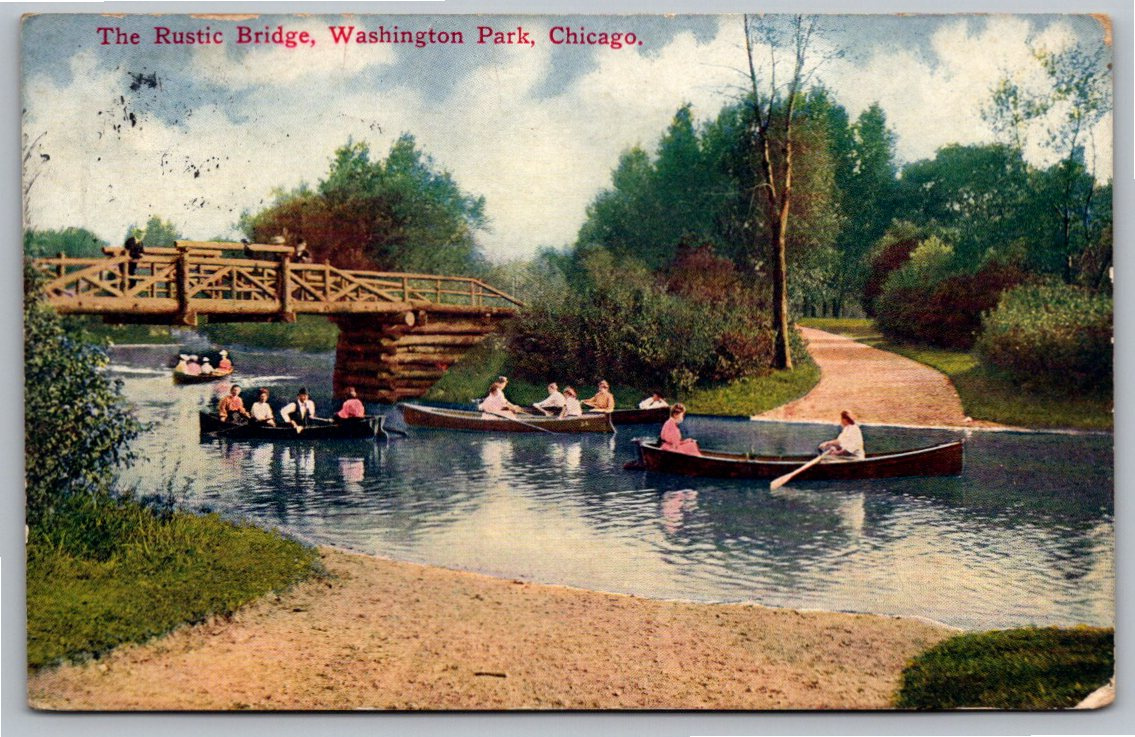
📸 Click any thumbnail to inspect Front, Back & Angles (2 Photos)
As an eBay Partner, we may earn a commission if you make a purchase.
Item Specifications
- Era: Divided Back (1907-1915)
- Year: 1910
- Location: Chicago, Illinois
- Subject: Washington Park Rustic Bridge
- Postmark Date: June 19, 1910
- Printing Technique: Color Lithograph
- Category: Postcards & Ephemera
- Format / Type: Vintage Postcards
Looking for Modern Alternatives?
Explore top-rated, modern Postcards & Ephemera and related historical accessories on Amazon.
Shop Postcards & Ephemera on Amazon →As an Amazon Associate, we earn from qualifying purchases.
Historical Context & Overview
A Window into Edwardian Chicago: Washington Park in 1910
In the early decades of the twentieth century, Chicago's expansive park systems provided urban residents with a welcome retreat from the industrial bustle of the metropolis. This vibrant color postcard, postmarked June 19, 1910, captures a quintessential summer afternoon scene at Washington Park on the city’s South Side. Leisurely paddlers navigate winding, mirror-like waterways in wooden canoes, passing beneath an intricately crafted timber bridge framed by lush, mature foliage.
Olmsted’s Vision and Rustic Park Architecture
Originally conceived in the late 1860s by master landscape architects Frederick Law Olmsted and Calvert Vaux—the famed duo behind New York City's Central Park—Washington Park was designed as the western anchor of Chicago's South Park system, connected to Jackson Park via the broad Midway Plaisance. Central to Olmsted's philosophy was the creation of pastoral, sweeping landscapes punctuated by naturalistic lagoons, islands, and serpentine watercourses ideal for recreational boating.
The "Rustic Bridge" depicted on the card showcases the popular late Victorian and Edwardian architectural motif of using unbarked timber, heavy logs, and organic forms to seamlessly blend structures into the surrounding scenery. These picturesque bridges provided elevated vantage points for strolling pedestrians while serving as charming landmarks for rowers and canoeists gliding down the park's interconnected canals.
A Snapshot of Postal and Social History
Beyond its scenic landscape value, the reverse of this antique postcard offers a fascinating glance into turn-of-the-century daily life. Mailed with a green one-cent Benjamin Franklin stamp, the card bears a clear "Chicago, Ill." machine postmark from June 1910. The handwritten message from the sender, H. Trotter, instructs the recipients in Gallatin, Missouri, to direct mail to the "Chicago & Alton R.R.," highlighting Chicago's role as the bustling center of American rail transportation during the period.
Preserving the Golden Age of Postcards
Produced during the peak of the Golden Age of Postcards (1907–1915), this piece represents the classic Divided Back era, when post office regulations first permitted personal messages on the left side of the reverse card. The delicate color-tinted lithography brings out the period attire of the parkgoers—including long dresses and boater hats—making this an exceptional historical document for collectors of Chicago history, landscape architecture, and early twentieth-century ephemera.