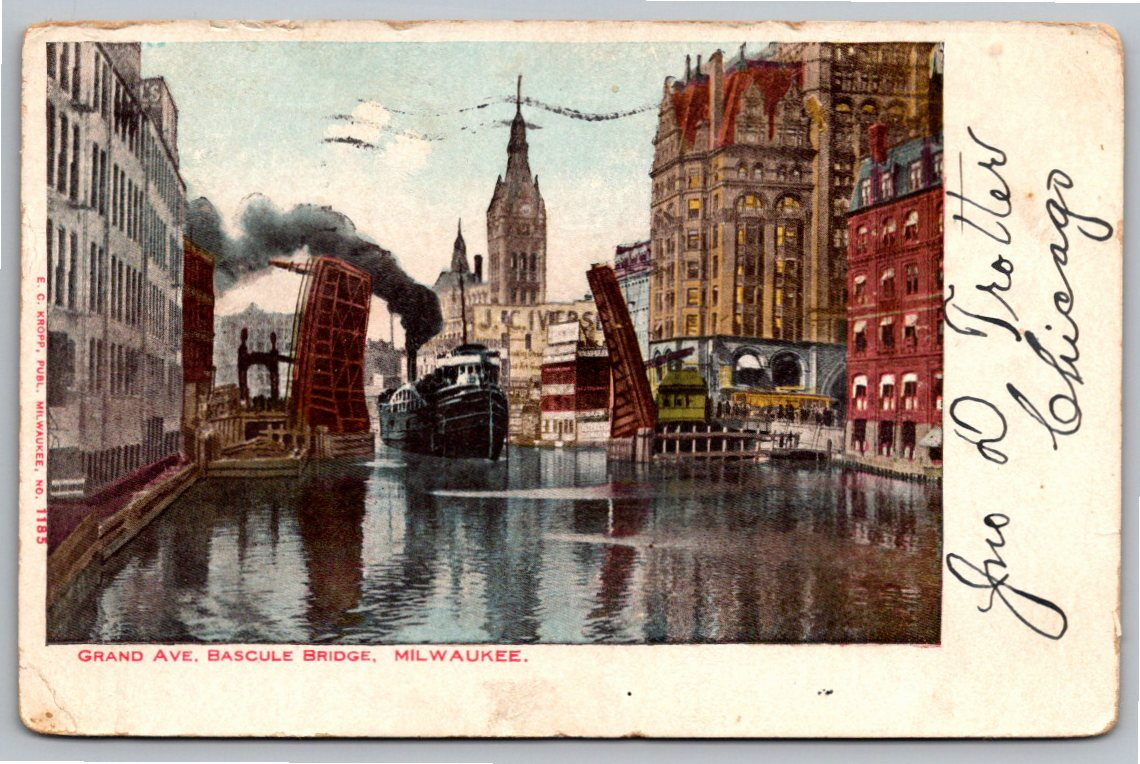
1905 Grand Avenue Bascule Bridge Milwaukee WI Postcard
📸 Click any thumbnail to inspect Front, Back & Angles (2 Photos)
As an eBay Partner, we may earn a commission if you make a purchase.
Item Specifications
- Era: Undivided Back (1901-1907)
- Publisher: E.C. Kropp
- Location: Milwaukee, Wisconsin
- Subject: Bascule Bridge & Milwaukee River
- Postmark Date: 1905
- Originality: Original Vintage
- Category: Postcards & Ephemera
- Format / Type: Vintage Postcards
Looking for Modern Alternatives?
Explore top-rated, modern Postcards & Ephemera and related historical accessories on Amazon.
Shop Postcards & Ephemera on Amazon →As an Amazon Associate, we earn from qualifying purchases.
Historical Context & Overview
A Snapshot of Industrial Milwaukee at the Turn of the Century
At the turn of the twentieth century, Milwaukee was rapidly transforming into one of the industrial powerhouses of the American Midwest. Central to this boom was the Milwaukee River, a working waterway humming with freight traffic, lake freighters, and coal-fired steamships. This original 1905 color lithograph postcard captures a dramatic scene of maritime commerce and modern municipal engineering along the river: a massive steamship belching dark smoke as it glides between the raised spans of the Grand Avenue Bascule Bridge.
Engineering the Riverways: The Bascule Bridge
As maritime traffic expanded alongside urban streetcar lines, Milwaukee civil engineers sought efficient solutions to cross the city's river system without stalling commercial shipping. The bascule bridge—derived from the French word for "seesaw"—featured heavy counterweighted leaves that pivoted upward quickly to open the channel. The Grand Avenue Bridge, situated along what is today Wisconsin Avenue in downtown Milwaukee, was a vital artery connecting the city's east and west commercial districts.
In the background of this rich illustration, the Flemish Renaissance tower of Milwaukee City Hall rises into the sky. Completed in 1895, the building was one of the tallest structures in the United States at the time and served as a proud symbol of civic identity for the city's large German-American population. Framed by brick warehouses, office blocks, and river docks, the scene captures the energy of an era when heavy industry and urban development converged along the water's edge.
Local Publishing Heritage: E.C. Kropp
This card holds special appeal for regional historians because it was produced directly in Milwaukee by E.C. Kropp, one of the premier postcard publishing houses in the United States. Founded by Emil C. Kropp in 1898, the firm produced millions of view cards documenting towns, landmarks, and industrial sites across North America. E.C. Kropp postcards from the early 1900s are celebrated for their fine color registration and detailed depiction of everyday American life during the Golden Age of postcards.
Postal Artifact of the Undivided Back Era
Dating to August 1905, this piece falls squarely within the "Undivided Back" period of American postcard history (1901–1907). Under United States postal regulations of the era, the back of a postcard was strictly reserved for the recipient's address. Senders were forced to squeeze personal messages onto the front border, as seen here with the handwritten ink signature in the right-hand margin.
The reverse side of the postcard offers a fascinating glimpse into early twentieth-century postal efficiency. Capped with a green one-cent Benjamin Franklin stamp, the card bears a clear "MILWAUKEE, WIS. AUG 14 5:30 PM 1905" machine cancellation, alongside an oval receiving stamp showing it arrived in "GALLATIN, MO. AUG 15 4 PM 1905"—reaching its Missouri destination less than twenty-four hours after being dropped in the mail in Wisconsin.