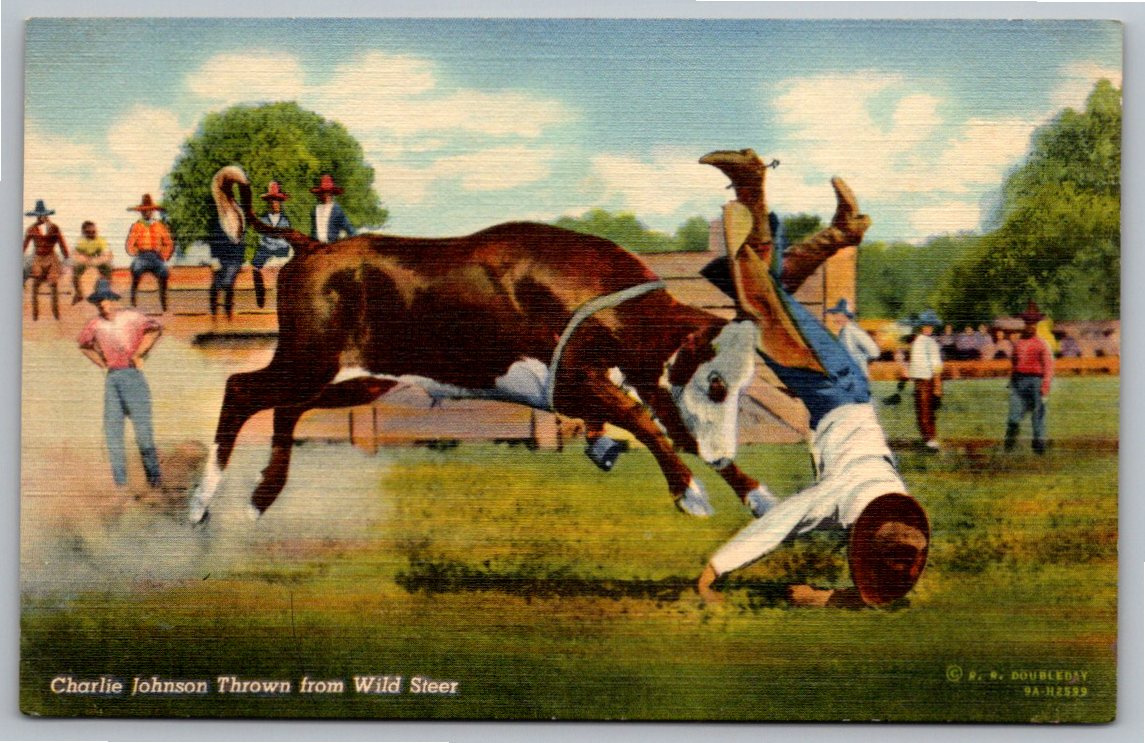
Vintage 1939 Rodeo Postcard: Charlie Johnson Thrown from Wild
📸 Click any thumbnail to inspect Front, Back & Angles (2 Photos)
As an eBay Partner, we may earn a commission if you make a purchase.
Item Specifications
- Era: 1930s Linen
- Publisher: Doubleday & Co.
- Printer: Curt Teich (C.T. Art-Colortone)
- Year: 1939
- Subject: Rodeo & Wild Steer Riding
- Location: Council Bluffs, Iowa
- Category: Postcards & Ephemera
- Format / Type: Printed Postcards
Looking for Modern Alternatives?
Explore top-rated, modern Postcards & Ephemera and related historical accessories on Amazon.
Shop Postcards & Ephemera on Amazon →As an Amazon Associate, we earn from qualifying purchases.
Historical Context & Overview
A Split-Second of Western Drama Captured in 1939
In the high-energy arena of American rodeo during the 1930s, victory and disaster were separated by mere fractions of a second. This original 1939 linen postcard presents one of the most dynamic action shots of the era, recording the perilous moment cowboy Charlie Johnson was catapulted upside-down from a thrashing steer. With his hat tumbling toward the dirt and boots suspended high in the air, the image captures the raw power and unpredictable danger that defined classic Western rodeo sports.
During the Great Depression and immediate pre-war years, rodeo surged in popularity across the United States. Events such as wild steer riding, calf roping, and bronc riding embodied the tough, romanticized spirit of the American frontier. Photographers who frequented these circuits faced significant risks themselves, standing close to the arena fences to capture split-second spills, powerful bucking motions, and authentic crowd reactions with vintage large-format cameras.
F. S. Doubleday and the Mid-Century Western Circuit
The card bears the copyright imprint of F. S. Doubleday and was distributed by Doubleday & Co., based out of Council Bluffs, Iowa. Publishers like Doubleday specialized in regional Western Americana, producing series that celebrated local county fairs, regional rodeos, and famous performers. By transforming real-life action photographs into mass-produced postcards, they allowed spectators to mail a piece of high-octane spectacle across the country to friends and family.
Unlike posed studio portraits of cowboys, action views depicting violent dismounts and buck-offs held immense visual appeal. The thrill of watching a rider test his grit against an untamed steer resonated deeply with audiences looking for authentic heroic storytelling in popular media.
The Mastery of Curt Teich Art-Colortone Linen Postcards
This artifact was produced by the legendary Curt Teich Company of Chicago, utilizing their patented "C.T. Art-Colortone" printing technique. Identifiable by the production code 9A-H2539 printed along the front and back, the code directly dates the printing run to 1939 ("9" for 1939, "A" for the 1930s decade, and "H" designating the Art-Colortone linen series).
Linen postcards were famous for their high rag-content paper fibers, which imparted a soft, woven tactile texture across the surface. This unique cardstock allowed printers to apply vibrant, saturated lithographic inks that created rich, painterly hues. Notice how the bright red shirts of the arena judges sitting atop the wooden chute fence contrast sharply against the dusty greens and earth tones of the arena dirt. The technique brought black-and-white rodeo photographs into living color, rendering every kicked-up cloud of dust and tense muscle in vivid detail.
An Enduring Western Artifact for Collectors
Today, vintage rodeo post cards from the linen era remain highly sought after by collectors of Western Americana, sports history enthusiasts, and ephemera curators. Unposted examples in clean condition—featuring clear publisher attributions and crisp imagery—serve as important visual records of early professional rodeo history. This snapshot of Charlie Johnson's dramatic spill stands as a timeless monument to the daring men and wild livestock that built the legend of the American West.