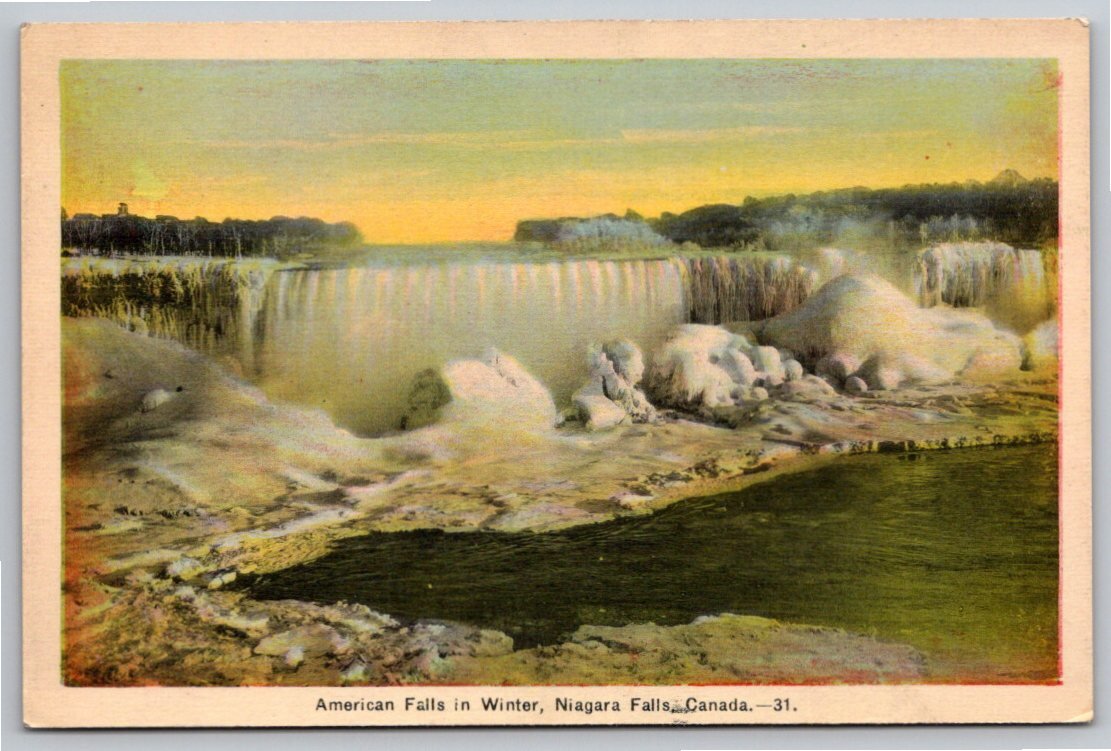
Vintage Niagara Falls Winter Postcard: American Falls PECO #31
📸 Click any thumbnail to inspect Front, Back & Angles (2 Photos)
As an eBay Partner, we may earn a commission if you make a purchase.
Item Specifications
- Era: 1930s-1940s
- Publisher: Photogelatine Engraving Co. (PECO)
- Location: Niagara Falls, Ontario, Canada
- Subject: American Falls Ice Formations
- Printing Technique: Photogelatine (Collotype)
- Originality: Original Vintage
- Category: Postcards & Ephemera
- Format / Type: Vintage Postcards
Looking for Modern Alternatives?
Explore top-rated, modern Postcards & Ephemera and related historical accessories on Amazon.
Shop Postcards & Ephemera on Amazon →As an Amazon Associate, we earn from qualifying purchases.
Historical Context & Overview
The Frozen Wonder of Niagara Falls in Winter
Few natural phenomena in North America have captivated the human imagination quite like Niagara Falls during the depths of winter. Long before modern photography and digital travel feeds, travelers and armchair adventurers relied on finely produced souvenir postcards to glimpse the formidable winter landscapes of the Niagara River. This vintage postcard, produced by the Photogelatine Engraving Company (PECO) of Ottawa, captures a serene yet dramatic view titled "American Falls in Winter, Niagara Falls, Canada."
The image highlights the immense accumulation of snow mounds and gigantic ice formations that gather along the base of the American Falls. As freezing spray billows into the frigid air, it coats surrounding rocks, cliff faces, and riverbed in heavy, sculpted layers of ice. Against a glowing horizon painted in warm sunset hues, the cascading water contrasts beautifully with the stark, frozen terrain below.
The Photogelatine Engraving Company (PECO) Legacy
Based in Ottawa, Ontario, the Photogelatine Engraving Co., Limited (commonly abbreviated as PECO) was one of Canada’s primary postcard producers during the early-to-mid 20th century. Utilizing the photogelatine printing method—also known as collotype—PECO was able to produce postcards with exceptionally fine photographic tonal gradations and soft, natural color tinting.
Unlike standard relief or offset printing methods of the era, collotype printing involved light-sensitive gelatine plates that reproduced photographic continuous tones without coarse dot screens. This rendered views of natural landscapes, waterfalls, and architectural landmarks with remarkable smoothness and subtlety. PECO postcards, recognized by their distinctive maple-leaf style emblem and centered vertical dividing line on the back, remain prized by deltiologists for their artistic fidelity and authentic representation of mid-century Canadian topographics.
Winter Spectacles and the Historic Ice Bridges
A Favorite Seasonal Landmark
During the late 19th and early 20th centuries, winter visitors flocking to Niagara Falls experienced sights unique to the season. Extreme cold weather frequently caused ice floes floating down Lake Erie to jam near the falls, forming a continuous sheet across the river known as the "Ice Bridge." In the Victorian era and early 1900s, tourists famously walked across this frozen bridge to set up temporary refreshment stands and admire the towering ice mounds—sometimes reaching over fifty feet high—that built up at the base of the cataract.
Although ice walking was eventually restricted for public safety after a severe ice bridge breakup in 1912, the sheer visual grandeur of winter at the falls remained a favorite subject for artists and photographers. Postcards like PECO card #31 offered a lasting keepsake of this subzero majesty, capturing the interplay between rushing water and frozen ice that draws visitors to the border region to this day.
A Treasured Piece of Canadian Deltiology
Preserved in unposted condition, this card offers enthusiasts a crisp glimpse into mid-20th-century Canadian publishing and landscape photography. Whether as part of a specialized Niagara Falls collection, a study of PECO print techniques, or an appreciation of vintage winter scenes, this card stands as an enduring testimonial to one of the continent's most awe-inspiring natural spectacles.