1944 Mid-Atlantic Map Vintage Linen Postcard: VA, WV, MD & DE
📸 Click any thumbnail to inspect Front, Back & Angles (2 Photos)
As an eBay Partner, we may earn a commission if you make a purchase.
Item Specifications
- Era: Linen Era (1930-1950)
- Year: 1944
- Publisher: Minsky Bros. & Co.
- Printer: Curt Teich & Co.
- Region: Mid-Atlantic US
- Postmark Date: April 28, 1944
- Category: Postcards & Ephemera
- Format / Type: Printed Postcards
Looking for Modern Alternatives?
Explore top-rated, modern Postcards & Ephemera and related historical accessories on Amazon.
Shop Postcards & Ephemera on Amazon →As an Amazon Associate, we earn from qualifying purchases.
Historical Context & Overview
Cartographic Nostalgia of the Mid-Atlantic
During the golden age of American road trips and postcard correspondence, regional map postcards emerged as prized souvenirs for travelers eager to chart their journeys across the nation. Produced during the height of World War II and postmarked in 1944, this vibrant linen postcard presents a detailed cartographic view encompassing Virginia, West Virginia, Maryland, and Delaware. Printed on high-rag content paper stock with a distinct embossed fabric texture, linen cards of this era captured the bold, saturated colors made famous by the Curt Teich Company of Chicago through their proprietary "C.T. Art-Colortone" process.
Linen postcards gained immense popularity in the 1930s and 1940s due to advances in lithographic printing that allowed vibrant dyes to absorb deep into the textured surface fibers. Curt Teich dominated this market, creating iconic state and regional map cards that served both practical navigation and promotional purposes. Distributed by Minsky Bros. & Co. out of Pittsburgh, Pennsylvania, this issue illustrates how regional publishing houses partnered with major printers to supply souvenir stands, drugstores, and bus stations throughout the Appalachian and Mid-Atlantic corridors.
Charting Historic Highways and Towns
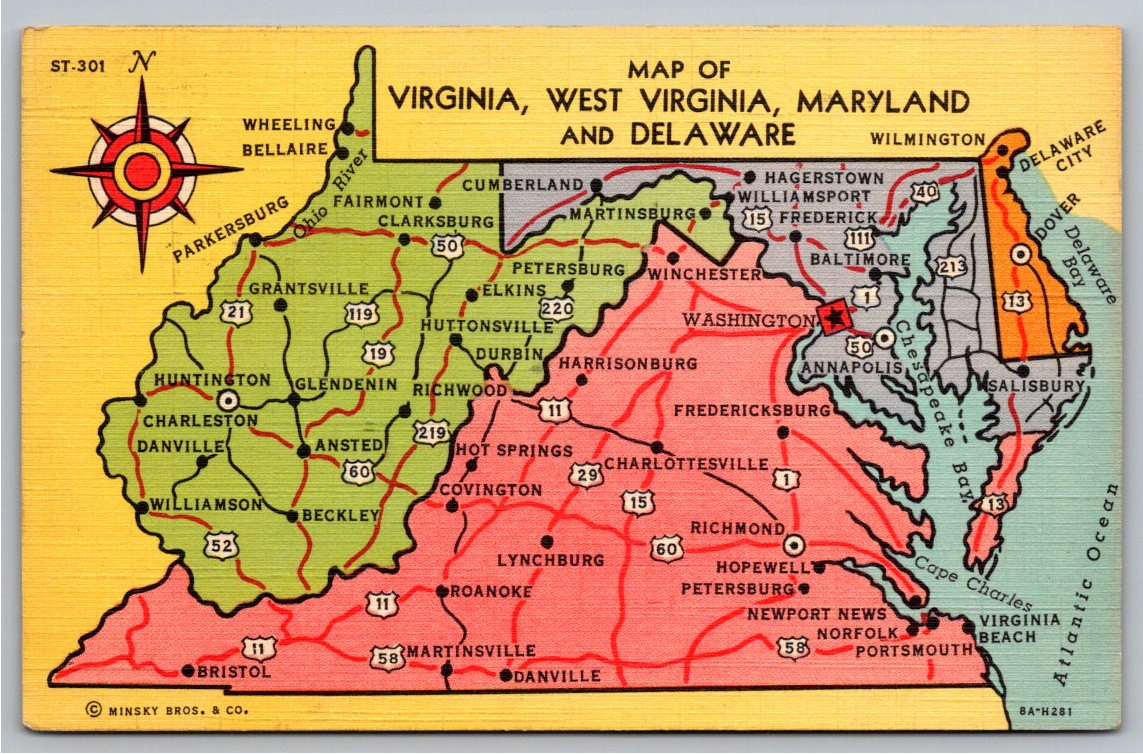
The visual centerpiece of this card is a color-coded cartographic rendering of the Mid-Atlantic states. West Virginia is rendered in lush green, Virginia in warm crimson-pink, Maryland in cool blue-gray, and Delaware in golden orange. Key federal highway arteries—including U.S. Routes 11, 40, 50, and 60—are prominently traced across the landscape, linking bustling industrial hubs and quiet mountain towns. From the coastal expanse of the Chesapeake Bay and Cape Charles to the mountainous contours of Elkins, Clarksburg, and Roanoke, the map highlights essential mid-20th-century routes that carried military transports, regional commerce, and wartime travelers.
A striking compass rose graces the upper left corner, reinforcing the classic navigational motif, while the lower border bears the copyright imprint of distributor Minsky Bros. & Co. The reverse side features Curt Teich's signature production line code, tracing the original graphic design to the late 1930s before its wartime reprinting.
Wartime Provenance and Daily Correspondence
Beyond its cartographic charm, this piece offers a captivating window into civilian life during World War II. Canceled on April 28, 1944, in Park, West Virginia, the postcard carries a green one-cent U.S. postage stamp depicting the torch from President Roosevelt's "Four Freedoms" series—a staple of wartime postal stationery emphasizing Freedom of Speech and Religion. Sent by sender Madolyn Swiger to Miss Eleanor Hamm in Kimmswick, Missouri, the handwritten message captures an authentic slice-of-life exchange: "Dear Eleanor... Can you get Map Cards there, Would like one if you can. We're having a nice day for a change."
A Worthy Addition for Historical Collectors
Whether evaluated as an authentic piece of World War II postal history, a snapshot of mid-century highway cartography, or an exemplar of Curt Teich linen printing, this 1944 postcard stands as a rich artifact of American heritage. Its preserved pigments, clear cancellation mark, and genuine personal message make it a compelling acquisition for map enthusiasts, regional historians, and deltiology collectors alike.