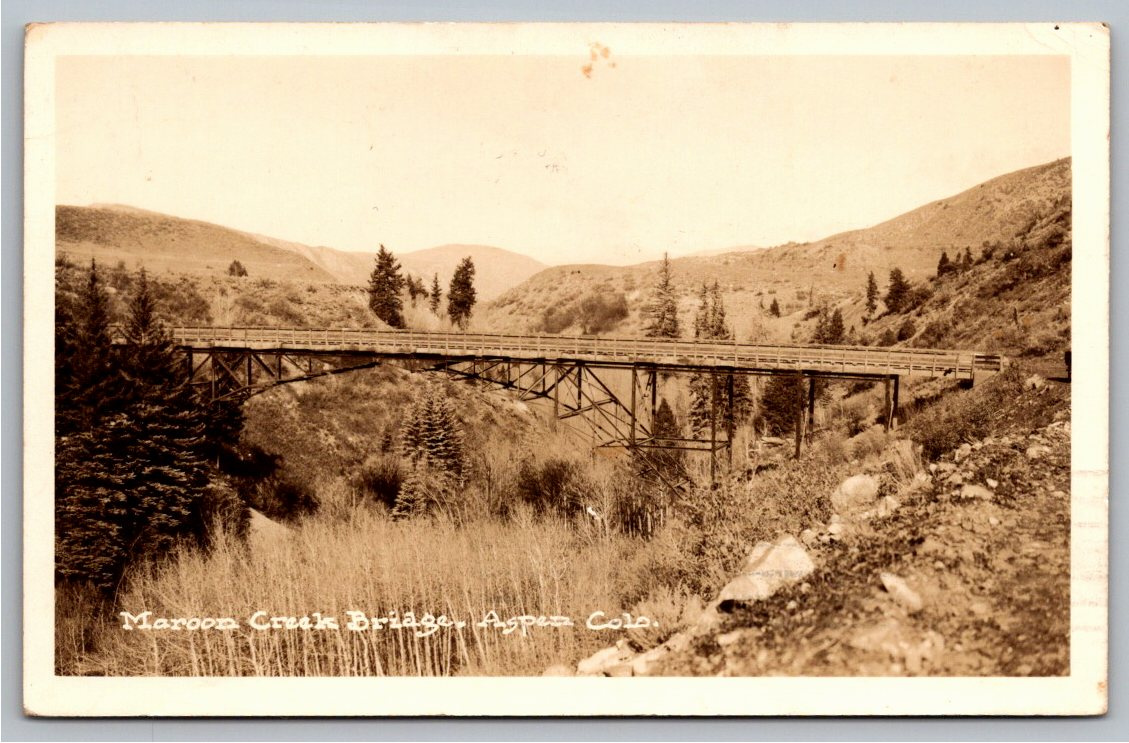
1939 Maroon Creek Bridge Aspen Colorado Vintage Real Photo
📸 Click any thumbnail to inspect Front, Back & Angles (2 Photos)
As an eBay Partner, we may earn a commission if you make a purchase.
Item Specifications
- Type: Real Photo Postcard (RPPC)
- Era: 1930s (1939)
- Location: Aspen, Colorado
- Subject: Maroon Creek Bridge Trestle
- Postmark Date: August 7, 1939
- Stamp: 1 Cent Washington Green
- Category: Postcards & Ephemera
- Format / Type: Real Photo Postcards (RPPC)
Looking for Modern Alternatives?
Explore top-rated, modern Postcards & Ephemera and related historical accessories on Amazon.
Shop Postcards & Ephemera on Amazon →As an Amazon Associate, we earn from qualifying purchases.
Historical Context & Overview
A Window into Pre-Boom Aspen: The 1939 Maroon Creek Bridge RPPC
Long before Aspen, Colorado, became synonymous with luxury mountain resorts and high-end ski culture, it was a quiet, unassuming former mining town nestled deep within the Roaring Fork Valley. This exceptional 1939 Real Photo Postcard (RPPC) captures a pivotal landmark of the region's civil engineering history: the Maroon Creek Bridge, framed against the rugged, sage-dotted slopes of the Rocky Mountains.
Real photo postcards offer a stark contrast to standard mass-produced color lithographs of the era. Produced by exposing a photographic negative directly onto photo-sensitive postcard paper, RPPCs preserve subtle tonalities, exceptional depth, and rich detail. In this view, the intricate metal lattice and timber framework of the bridge stretch across the dramatic expanse of the Maroon Creek gorge, demonstrating the technical ambition required to connect isolated mountain communities during the late 19th and early 20th centuries.
Engineering the Roaring Fork Valley
The original Maroon Creek bridge site was established in 1888 by the Colorado Midland Railway, which constructed a soaring steel trestle to carry heavy locomotives laden with silver ore, coal, and passengers into Aspen. As the silver boom waned around the turn of the century and rail traffic diminished, regional infrastructure adapted. The elevated crossing over Maroon Creek remained an essential artery, eventually transitioning to support vehicular traffic along the route leading toward Maroon Bells and Glenwood Springs.
In 1939, when this photograph was captured, Aspen was situated in what historians often call its "Quiet Years." Following the collapse of the silver market in 1893, the population had plummeted, leaving behind empty Victorian homes and quiet streets. However, the late 1930s marked the very beginning of Aspen's second rebirth. Adventurers and winter sports enthusiasts were just starting to realize the potential of the surrounding peaks, laying the groundwork for what would soon become a global alpine destination following the conclusion of World War II.
Postal History and Social Ephemera
The reverse side of this postcard adds a compelling layer of social provenance. Stamped with a crisp, circular postmark reading "ASPEN COLO. AUG 7 11 30AM 1939," the card bears a green one-cent George Washington postage stamp. The brief, handwritten message—sent from a traveling father ("dad") to his mother in Louisburg, Kansas—captures a fleeting moment of everyday mid-century American travel history.
For collectors of Colorado regional ephemera, rail transport heritage, or early American photography, this 1939 Real Photo Postcard serves as a tangible link to Aspen’s transitional era—a quiet, historic moment preserved in silver halide chemistry just prior to the town's legendary transformation.