1917 Packard Twin Six Touring Car Original Vintage Photograph
📸 Click any thumbnail to inspect Front, Back & Angles (2 Photos)
As an eBay Partner, we may earn a commission if you make a purchase.
Item Specifications
- Era: 1910s
- Year: c. 1917
- Subject: Packard Twin Six Touring Car
- Automotive Brand: Packard Motor Car Company
- Engine Type: 60-Degree V12 (Twin Six)
- Originality: Original Vintage B&W Photo
- Category: Vintage Photography
- Format / Type: Snapshots
Looking for Modern Alternatives?
Explore top-rated, modern Vintage Photography and related historical accessories on Amazon.
Shop Vintage Photography on Amazon →As an Amazon Associate, we earn from qualifying purchases.
Historical Context & Overview
An Icon of Early Luxury: The 1917 Packard Twin Six
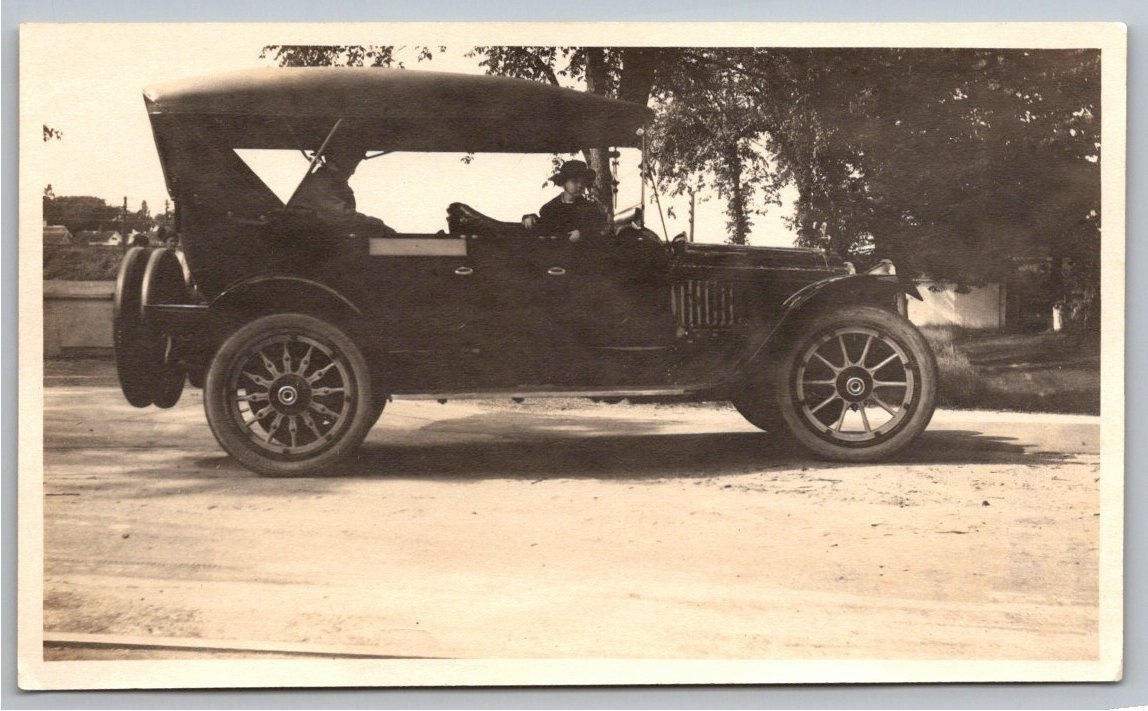
In the late 1910s, the American automobile industry experienced a quiet revolution driven by engineering precision and refined luxury. At the absolute forefront of this movement stood the Packard Motor Car Company and its groundbreaking flagship model: the Packard Twin Six. Introduced in late 1915 for the 1916 model year, the Twin Six represented the world’s first mass-production V12 automotive engine, instantly establishing Packard as the supreme arbiter of American prestige motoring. This original black-and-white photographic snapshot captures a magnificent circa 1917 Packard Twin Six Touring Car in all its period glory, parked along a sunlit dirt road.
Engineering Excellence in the Nickel Era
Designed under the brilliant guidance of Packard chief engineer Jesse G. Vincent, the Twin Six engine featured two banks of six cylinders angled at 60 degrees. Producing roughly 88 horsepower—an extraordinary output for the late 1910s—the V12 delivered unprecedented smoothness, effortless torque, and near-silent operation that made contemporary inline-four and six-cylinder engines feel unrefined by comparison. Industrial leaders, celebrities, and world heads of state quickly adopted the Twin Six, solidifying Packard's famous slogan: "Ask the Man Who Owns One."
Anatomy of a Classic Touring Car
The crisp side profile preserved in this original snapshot showcases the majestic proportions of Packard's open touring body style. Positioned prominently are the classic wooden spoke artillery wheels, heavy multi-ply pneumatic tires, and dual rear-mounted spare tires wrapped neatly at the back of the chassis. The tall radiator shell, sweeping front fenders, and high-riding open-air cabin with its upright fabric soft top erect illustrate the transition from horse-drawn carriage aesthetics to purpose-built, high-speed automotive engineering.
A Window into Early Motoring Culture
Personal photography during the First World War era captured real-world motoring in candid detail. Unlike polished corporate advertising prints or factory catalog illustrations, authentic vernacular snapshots like this preserve genuine motorists enjoying their high-end vehicles in everyday environments. Seated inside the open passenger compartment, the figures present a fascinating cross-section of early 20th-century road travel, framed by period fashion and wide-brimmed hats. The unpaved roadway beneath the heavy wooden wheels speaks directly to the primitive state of American highway infrastructure prior to the national road-building booms of the 1920s.
A Choice Artifact for Automotive Historians
For automotive historians, Packard enthusiasts, and vintage black-and-white photography collectors, original snapshots from the early brass and nickel eras remain invaluable primary documents. This authentic photograph captures the intersection of groundbreaking mechanical design, social prestige, and everyday American life during a pivotal moment in transportation history. As surviving examples of the original Twin Six become ever rarer, surviving period photographs serve as tangible links to the golden age of luxury American coachbuilding.