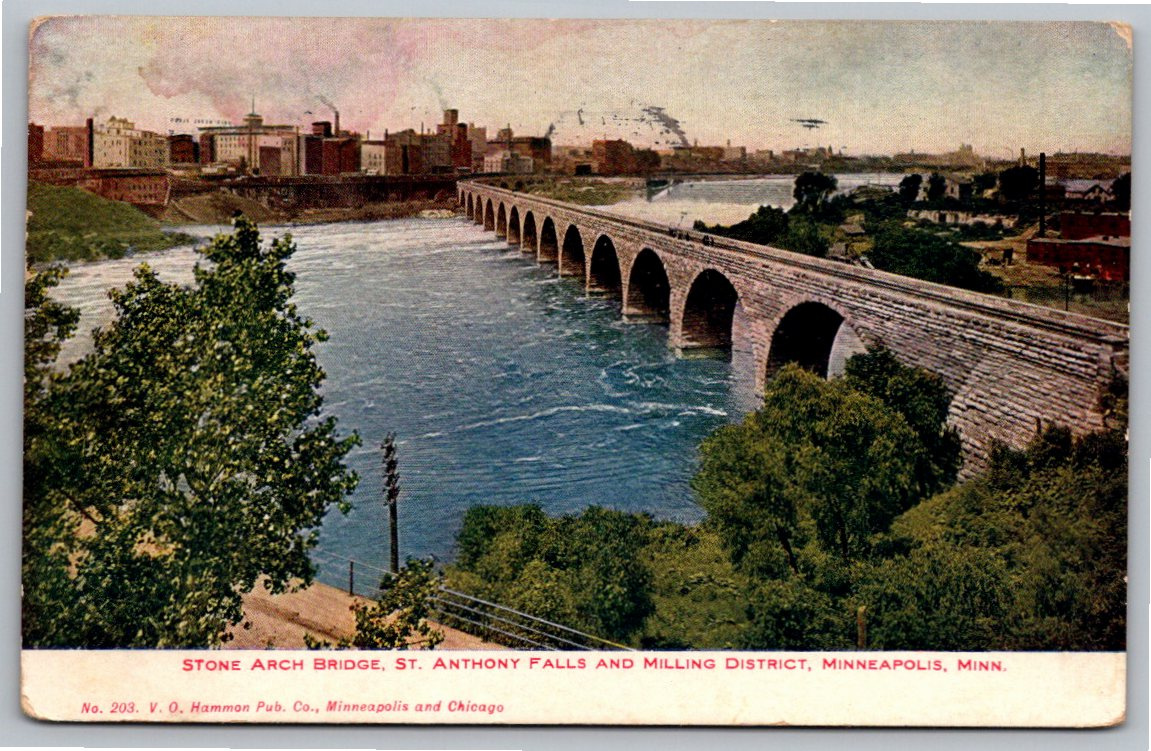
1910 Stone Arch Bridge & St. Anthony Falls Minneapolis MN
📸 Click any thumbnail to inspect Front, Back & Angles (2 Photos)
As an eBay Partner, we may earn a commission if you make a purchase.
Item Specifications
- Era: Divided Back (1907-1915)
- Year: 1910
- Publisher: V. O. Hammon Publishing Co.
- Location: Minneapolis, Minnesota
- Subject: Stone Arch Bridge & Milling District
- Printing Tech: Color Lithograph
- Category: Postcards & Ephemera
- Format / Type: Vintage Postcards
Looking for Modern Alternatives?
Explore top-rated, modern Postcards & Ephemera and related historical accessories on Amazon.
Shop Postcards & Ephemera on Amazon →As an Amazon Associate, we earn from qualifying purchases.
Historical Context & Overview
In the early twentieth century, Minneapolis, Minnesota, stood as an undisputed powerhouse of American industry. Celebrated as the "Flour Milling Capital of the World," the city derived its strength from the rushing torrents of St. Anthony Falls along the Mississippi River. This original 1910 color lithograph postcard captures that golden era in vivid detail, showcasing the iconic Stone Arch Bridge stretching gracefully across the water against a skyline dominated by grain elevators, mills, and billowing smoke stacks.
James J. Hill’s Engineering Triumph
Completed in 1883 by railroad tycoon James J. Hill’s Minneapolis Union Railway Company, the Stone Arch Bridge is a monumental engineering feat of the Gilded Age. Constructed entirely of native Minnesota granite and limestone, the bridge features 23 majestic masonry arches spanning over 2,100 feet. It was designed specifically to carry passenger rail traffic across the Mississippi River into downtown Minneapolis, serving as a critical gateway for westward expansion and trade.
The perspective featured on this postcard highlights the curve of the bridge as it spans the river just below St. Anthony Falls. The natural hydro power generated by the falls fueled the booming flour mills visible along the riverbanks, including giants like the Washburn-Crosby Company (later General Mills) and Pillsbury. To contemporary viewers in 1910, this vista represented the ultimate harmony of nature, heavy industry, and human ingenuity.
A Snapshot of Golden Era Printing
Published by the prominent V. O. Hammon Publishing Company of Minneapolis and Chicago, this postcard is a prime sample of early postcard production from the Golden Age of Postcards (1898–1915). Printed via tint lithography, the card exhibits rich tones—soft pinks in the sky, deep emerald greens along the riverbanks, and striking blue water—giving the industrial landscape an artistic, romanticized quality.
The reverse side features a crisp divided back format, which was officially recognized by the United States Postal Service in 1907, allowing senders to write messages on the left half while reserving the right side exclusively for the recipient's address. Cancelled with a clear St. Paul, Minnesota postmark dated December 10, 1910, the card bears a green one-cent Benjamin Franklin postage stamp (Scott #300 / #331 era).
A Personal Note Frozen in Time
Beyond its value as a architectural and regional historic document, the handwritten message on the back provides a charming window into daily Midwestern life during the winter of 1910. Sent to a recipient in St. Louis, Missouri, the writer remarks on the crisp local weather: "Climate fine—it's great. Everything here is on runners, the snow is so dry it doesn't dampen your shoes. It is simply great air."
Today, the Stone Arch Bridge is listed on the National Register of Historic Places and serves as a beloved pedestrian walkway, offering panoramic views of the very milling district commemorated on this vintage piece. For collectors of Minnesota history, railroading memorabilia, and turn-of-the-century urban landscapes, this antique postcard remains an enduring artifact of the Twin Cities' industrial heritage.