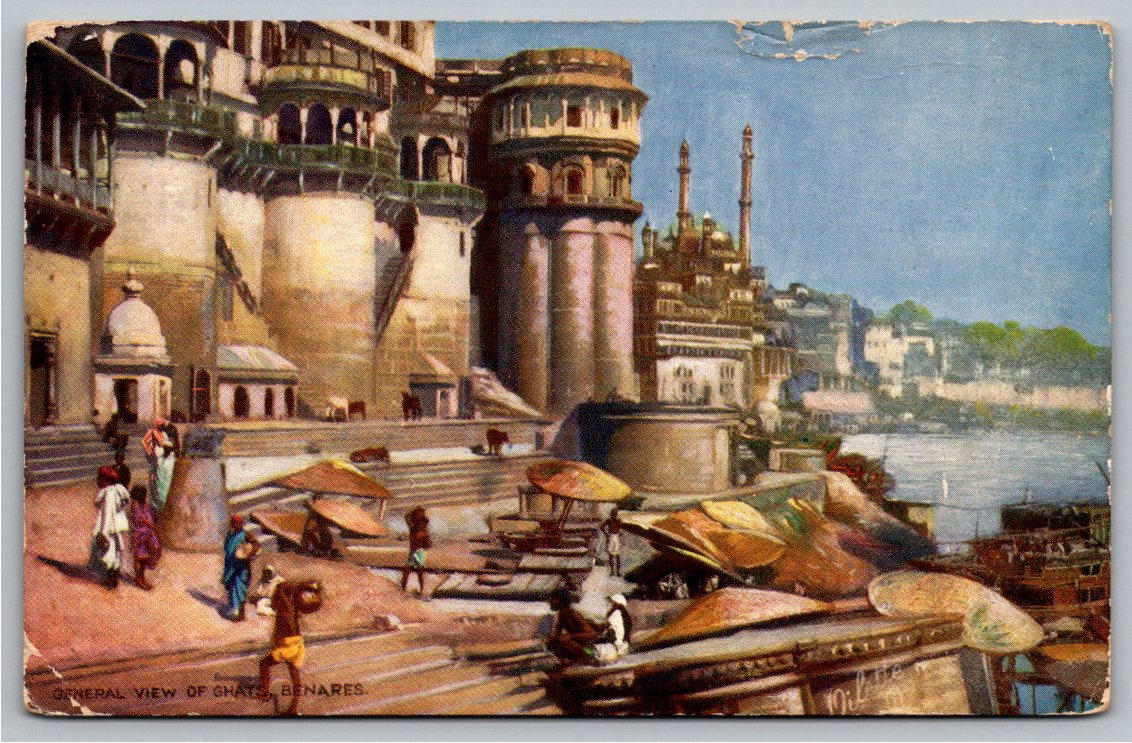
1910 General View of Ghats Benares India Tuck Oilette Postcard
📸 Click any thumbnail to inspect Front, Back & Angles (2 Photos)
As an eBay Partner, we may earn a commission if you make a purchase.
Item Specifications
- Era: 1910s Divided Back
- Publisher: Raphael Tuck & Sons
- Series: Wide Wide World - Benares
- Location: Varanasi (Benares), India
- Subject: Ghats of the Ganges River
- Postcard Series Number: 7239
- Category: Postcards & Ephemera
- Format / Type: Vintage Postcards
Looking for Modern Alternatives?
Explore top-rated, modern Postcards & Ephemera and related historical accessories on Amazon.
Shop Postcards & Ephemera on Amazon →As an Amazon Associate, we earn from qualifying purchases.
Historical Context & Overview
A Painted Window into Early 20th-Century Varanasi
In the early decades of the twentieth century, postcard publishing reached an artistic zenith, capturing distant cultures and sacred landscapes for a fascinated global audience. This remarkable antique postcard, produced around 1910 by the renowned British publishing house Raphael Tuck & Sons, offers a vivid artistic rendering of the riverfront ghats at Benares (modern-day Varanasi), India. Issued under Tuck's celebrated "Oilette" trademark as part of the "Wide Wide World" series (No. 7239), the card illustrates the towering stone architecture and bustling spiritual life along the sacred Ganges River.
The Sacred Waterfront of the Ganges
Varanasi, historically known to European travelers as Benares, stands as one of the world's oldest continually inhabited cities and the spiritual heart of Hinduism. The city's famous riverfront is defined by its massive stone stairways, or ghats, which descend directly into the waters of the Ganges. Constructed largely during the 18th and 19th centuries under the patronage of Maratha kings, local maharajas, and wealthy patrons, these grand structures served both practical and devotional purposes.
Tuck’s artwork captures the architectural splendor of these riverside palaces and temples, showcasing the massive circular stone bastions, open arcades, and soaring minarets that line the bank. Down at the water's edge, figures gather under large woven umbrellas—a characteristic sight of the Benares waterfront, where priests and pilgrims perform daily rituals, ablutions, and meditation along the steps.
Raphael Tuck & Sons and the "Oilette" Process
Founded in London in 1866, Raphael Tuck & Sons became the world's premier postcard publisher, earning a Royal Warrant from the British monarchy. Among their most prized innovations was the "Oilette" process, introduced around 1903. This printing technique mimicked the rich colors, brushed textures, and luminous qualities of original oil paintings, allowing affordable printed media to possess the aesthetic charm of fine art.
The "Wide Wide World" series was specifically designed to satisfy the Edwardian era's passion for armchair travel and empire visual culture. By commissioning talented illustrators to paint scenes of international landmarks, Tuck brought the sights of South Asia to homes across Britain, Europe, and the United States.
Postal Artifact and Ephemera Value
Beyond its visual appeal, the reverse side of this postcard tells a fascinating story of early 20th-century global correspondence. Postmarked in St. Louis, Missouri, on April 23, 1910, and featuring a green 1-cent Benjamin Franklin postage stamp, the card was mailed across the American Midwest to Gallatin, Missouri. The handwritten message provides an intimate glimpse into personal correspondence of the era, preserving a tangible bridge between British art printing, Indian holy geography, and American postal history.