Vintage 1908 St. Louis Forest Park Fountain Color Postcard
📸 Click any thumbnail to inspect Front, Back & Angles (2 Photos)
As an eBay Partner, we may earn a commission if you make a purchase.
Item Specifications
- Era: Divided Back (1907-1915)
- Postmark Date: June 10, 1908
- Publisher: The Ullman Manufacturing Co.
- Location: St. Louis, Missouri
- Subject: Forest Park Fountain
- Originality: Original Vintage Postcard
- Category: Postcards & Ephemera
- Format / Type: Vintage Postcards
Looking for Modern Alternatives?
Explore top-rated, modern Postcards & Ephemera and related historical accessories on Amazon.
Shop Postcards & Ephemera on Amazon →As an Amazon Associate, we earn from qualifying purchases.
Historical Context & Overview
A Gilded Age Jewel in St. Louis: The 1908 Forest Park Fountain
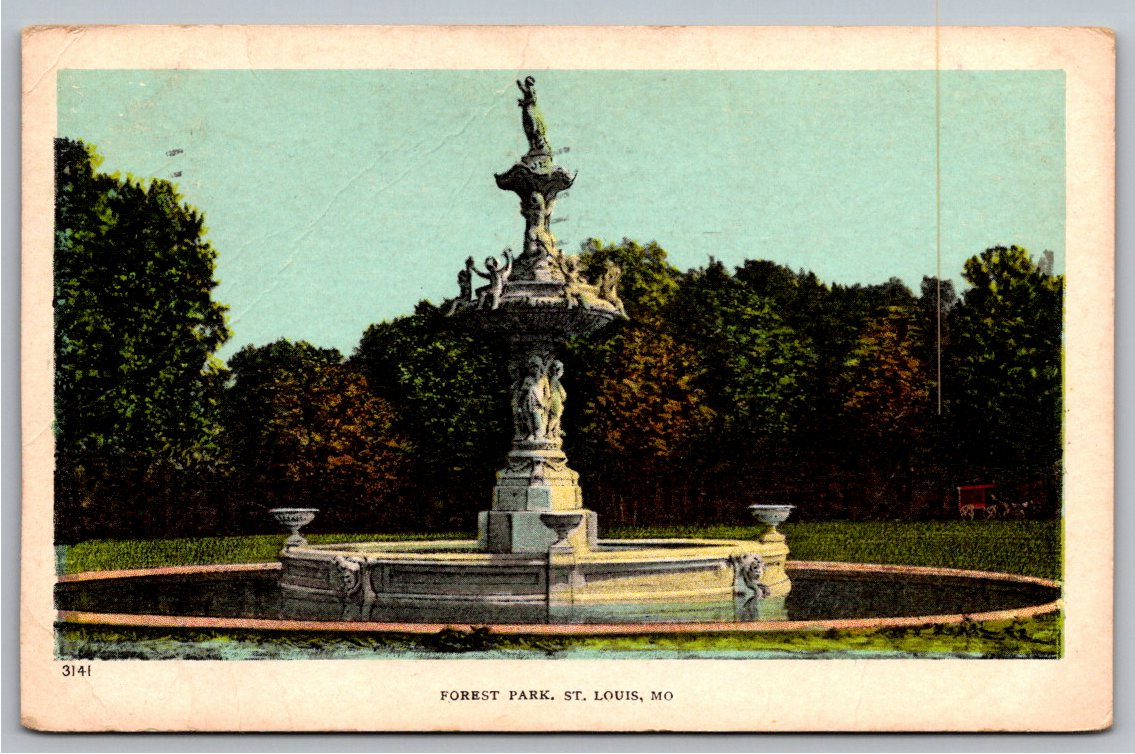
In the aftermath of the 1904 Louisiana Purchase Exposition (St. Louis World's Fair), Forest Park solidified its reputation as one of America's premier urban civic spaces. Designed as a sanctuary of natural beauty, grand architecture, and cultural institutions, the park featured sweeping lawns, serene waterways, and elaborate ornamental structures. Among its most beloved turn-of-the-century features was the magnificent multi-tiered fountain captured on this early 20th-century color postcard, postmarked in June of 1908.
The image offers a vibrant glimpse into the aesthetic values of turn-of-the-century landscape architecture, showcasing an elaborate cast-metal fountain adorned with classic classical statuary, cascading basins, and playful cherubic motifs rising from a wide circular reflection pool.
Civic Grandeur and Park Architecture in the Early 20th Century
During the Gilded Age and Progressive Era, American cities invested heavily in public parks to promote public health, recreation, and civic pride. Forest Park in St. Louis, officially dedicated in 1876, grew to encompass over 1,300 acres—surpassing even New York City's Central Park in size. Elaborate decorative fountains served both a aesthetic and practical purpose, providing cooling mist, relaxing ambient sound, and a central focal point for strolling visitors dressed in period attire.
This printed view captures the interplay between sculpted ironwork and lush foliage. In the lower right corner, a horse-drawn carriage can be glimpsed beneath the dense canopy of trees, emphasizing the transition era when traditional transport still dominated American park paths alongside newly emerging automobiles.
Publishing Craftsmanship: The Ullman Manufacturing Co. Legacy
This postcard was produced by The Ullman Manufacturing Company of New York, an influential publisher active during the Golden Age of Postcards (1898–1915). Ullman was renowned for high-quality lithographic printing techniques that imparted rich color saturation and soft tinting, giving black-and-white photography a painterly warmth. The tinted blue sky, rich greens of the woodland backdrop, and subtle stone accents demonstrate the fine color chromolithography typical of American publishers responding to the postcard craze sweeping the nation.
A Tangible Artifact of American Postal History
Beyond its visual appeal, the reverse side of this card carries rich historical documentation. Postmarked on June 10, 1908, at the main St. Louis post office, it bears a green one-cent Benjamin Franklin stamp. The message side reflects the "Divided Back" era, which had been authorized by the U.S. Postmaster General just one year prior in March 1907. This regulatory change permitted senders to write personal correspondence on the left side of the back, leaving the front entirely reserved for full-bleed artwork. Addressed to Bluff City, Kansas, this artifact serves as an authentic piece of social history, connecting everyday Missourians with rural communities across the Midwest over a century ago.