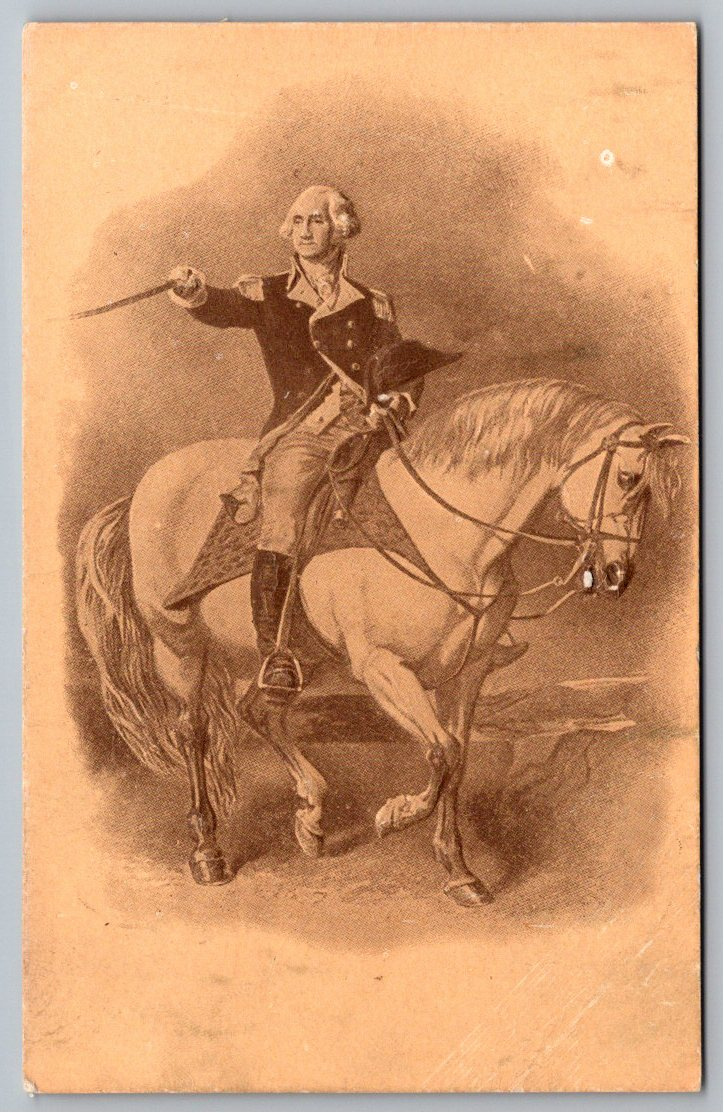
Antique George Washington Horseback Embossed Undivided Back
📸 Click any thumbnail to inspect Front, Back & Angles (2 Photos)
As an eBay Partner, we may earn a commission if you make a purchase.
Item Specifications
- Era: 1900s Undivided Back
- Subject: George Washington
- Card Type: Embossed Postcard
- Theme: American History & Military
- Postmark Status: Unposted
- Originality: Original Vintage
- Category: Postcards & Ephemera
- Format / Type: Vintage Postcards
Looking for Modern Alternatives?
Explore top-rated, modern Postcards & Ephemera and related historical accessories on Amazon.
Shop Postcards & Ephemera on Amazon →As an Amazon Associate, we earn from qualifying purchases.
Historical Context & Overview
In the early twentieth century, American patriotic sentiment flourished across the medium of visual print culture, nowhere more prominently than in the booming postcard market. This striking sepia-toned vintage postcard presents General George Washington mounted atop his charger, drawing inspiration from classical military portraiture of the late eighteenth and nineteenth centuries. Portrayed as the Commander-in-Chief of the Continental Army, Washington gestures heroically with his drawn sword while holding his tricorn hat, embodying the steadfast leadership that defined the founding of the United States.
An Iconic Portrait of Revolutionary Patriotism
The imagery rendered on this card aligns closely with celebrated martial paintings by American masters such as John Trumbull and Rembrandt Peale, who frequently immortalized Washington in heroic military poses during pivotal Revolutionary War campaigns. Rather than portraying him solely as a statesman or president, early postcard publishers favored depicting Washington on horseback to evoke themes of courage, tactical bravery, and equestrian dignity. The rich monochromatic sepia tones impart a timeless, archival quality that enhances the dramatic shading of his uniform, coat, and horse.
The Artistry of Early 20th-Century Relief Embossing
What distinguishes this piece among turn-of-the-century print ephemera is its fine relief embossing. During the Golden Age of Postcards (roughly 1898 to 1915), high-end card printers—frequently based in Saxony and chromolithographic hubs across Germany—utilized heavy metal dies to press raised relief patterns into cardstock. Looking at the reverse side of the card, the deep impressions of Washington, his horse, and his outstretched sabre are distinctly sculpted in tactile relief. This combination of fine ink printing and structural debossing created a dimensional visual effect highly sought after by period collectors and senders alike.
The Undivided Back Era: A Window Into Postal History
Postal historians will immediately recognize the distinct structural marker on the reverse: an undivided back layout. United States postal regulations strictly required that the back of a postcard be reserved exclusively for the recipient's mailing address until March 1, 1907, when Congress officially permitted messages to share the back alongside the address. Consequently, postcards printed during the "Undivided Back Era" (1901–1907) represent a specific historic window in American postal evolution. Any personal correspondence during this timeframe had to be scribbled neatly on the front margins, leaving the back reserved for the postage stamp and delivery details.
Collecting Presidential & Patriotic Ephemera
As an unposted artifact, this postcard remains a pristine example of early twentieth-century patriotic printing. For collectors of Washingtoniana, military iconography, and antique postal artifacts, items from this era offer an tangible connection to how Americans celebrated their national heritage at the turn of the century. Whether preserved in an archival collection or displayed in a curated historic setting, this embossed horseback study stands as a superb testament to early American printmaking and patriotic design.