WWI US Army Soldier in Campaign Hat RPPC Portrait: Howard
📸 Click any thumbnail to inspect Front, Back & Angles (2 Photos)
As an eBay Partner, we may earn a commission if you make a purchase.
Item Specifications
- Era: World War I (c. 1917–1920)
- Photographic Process: Real Photo Postcard (RPPC)
- Paper Stock: AZO (Two Triangles Up, Two Down)
- Subject: US Army Doughboy / Soldier
- Identified Subject: Howard Allender
- Uniform Details: M1917 Wool Tunic, Puttees, Campaign Hat
- Category: Postcards & Ephemera
- Format / Type: Real Photo Postcards (RPPC)
Looking for Modern Alternatives?
Explore top-rated, modern Postcards & Ephemera and related historical accessories on Amazon.
Shop Postcards & Ephemera on Amazon →As an Amazon Associate, we earn from qualifying purchases.
Historical Context & Overview
A Poignant Window into the Great War: The Doughboy Portrait
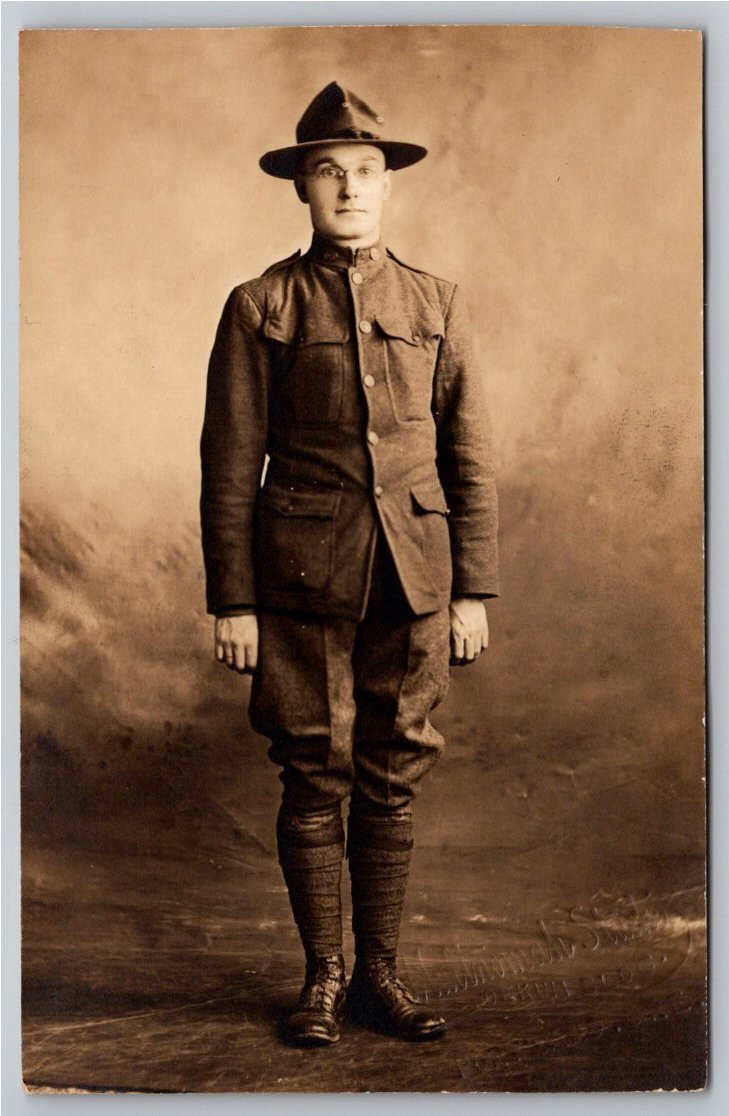
During the frantic mobilization of the United States into World War I, millions of young men traded civilian attire for olive drab wool uniforms. Among the most cherished keepsakes produced during this epoch were Real Photo Postcards (RPPCs), allowing soldiers to send high-fidelity, studio-quality likenesses home to anxious families. This remarkable full-length portrait captures a US Army Doughboy posed proudly in a professional studio setting, offering military historians and vintage photo collectors an exceptional study in World War I American uniform textiles and equipment.
Detailed Uniform and Studio Iconography
The soldier stands erect against a painted cloud backdrop, fully outfitted in standard-issue American Expeditionary Forces (AEF) field attire. He wears the classic M1912/M1917 wool service coat featuring a high standing collar, symmetrical flap pockets, and front brass buttons. Atop his head sits the iconic felt Campaign Hat—popularly referred to as the "Montana Peak" or "lemon squeezer"—which was standard dress for American soldiers training in stateside camps and serving domestically during the Great War era.
Descending to his footwear, the soldier wears wool service breeches secured at the lower legs by tightly wrapped spiral puttees (leg bandages) extending down to his leather ankle boots. Distinctive personal touches, such as his wire-rimmed prescription spectacles, add a profound human dimension to the image, bridging the gap between historical artifact and individual biography.
Dating through Photographic Paper Stock
The reverse side of the postcard features a classic divided back with a clear Kodak AZO stamp box. The configuration of the corner triangles—two pointing up and two pointing down—dates the manufacture of this Real Photo Postcard stock precisely between 1918 and 1930. This perfectly aligns with the tail end of World War I mobilization, the return of American forces from Western Europe, and the demobilization period immediately following the Armistice.
Identified Subject: Howard Allender
What elevates this particular military RPPC above anonymous portraits is the crisp pencil inscription on the reverse reading "Howard Allender." Named Doughboy photographs hold a special place in military archivism, as they grant researchers and genealogists the potential to cross-reference National Archives service records, draft registration cards, and unit rosters to trace the exact combat or support history of the serviceman depicted.
A Heritage Keepsake for Collectors
As genuine World War I paper ephemera grows increasingly scarce, original studio RPPCs displaying complete toe-to-head uniform detail remain highly sought after. This photograph serves not only as an exquisite piece of early 20th-century American portraiture, but also as an enduring monument to the individual servicemen who stepped forward during one of history's defining global conflicts.