Antique 1908 Thanksgiving Postcard: St. Bernard Dog & Ducks
📸 Click any thumbnail to inspect Front, Back & Angles (2 Photos)
As an eBay Partner, we may earn a commission if you make a purchase.
Item Specifications
- Era: Divided Back (1907-1915)
- Publisher: German American Novelty Art
- Series: Series No. 700
- Country of Origin: Germany
- Subject: St. Bernard Dog, Puppies & Ducks
- Occasion: Thanksgiving
- Category: Postcards & Ephemera
- Format / Type: Vintage Postcards
Looking for Modern Alternatives?
Explore top-rated, modern Postcards & Ephemera and related historical accessories on Amazon.
Shop Postcards & Ephemera on Amazon →As an Amazon Associate, we earn from qualifying purchases.
Historical Context & Overview
A Pastoral Holiday Scene from the Golden Age of Postcards
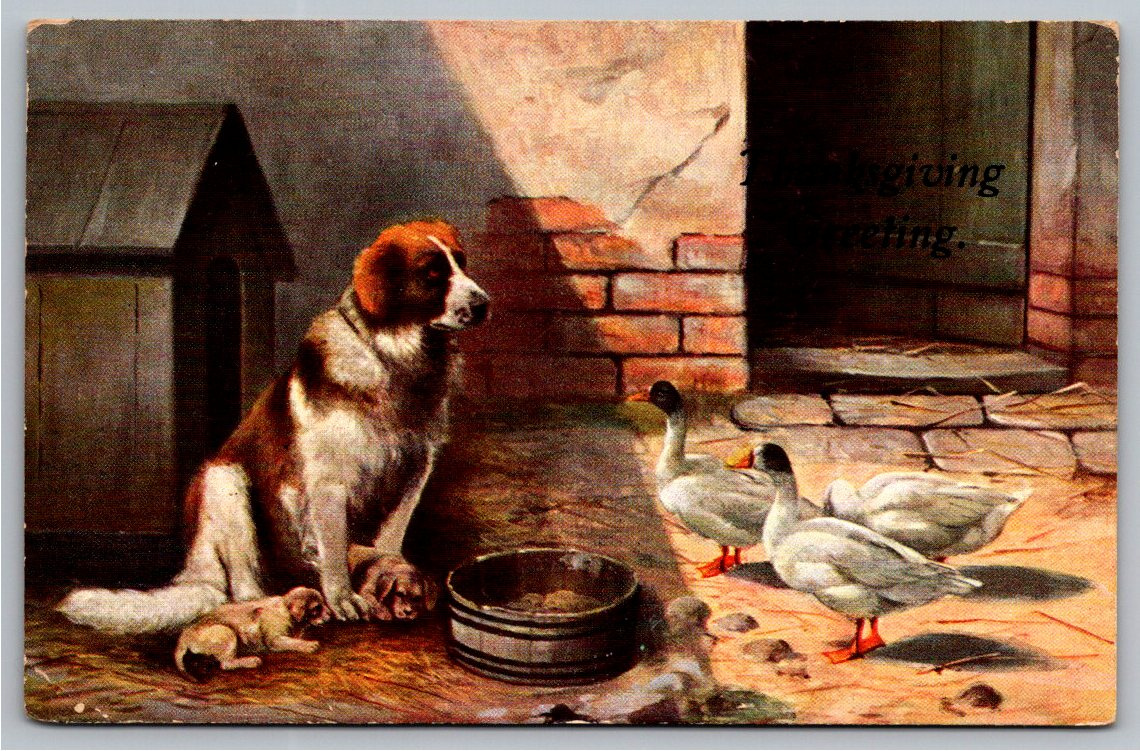
During the Golden Age of Postcards—spanning roughly from 1907 to 1915—holiday greetings transformed into an expressive art form exchanged across millions of American households. While modern Thanksgiving imagery often focuses heavily on harvest motifs, cornucopias, or roast turkeys, Edwardian-era publishers frequently embraced warm, pastoral scenes depicting domestic animal companionship. This exceptional c. 1908 Thanksgiving postcard captures that nostalgic sentiment, featuring a noble St. Bernard mother watching over her small puppies in a barnyard as a flock of curious ducks waddles nearby.
German Chromolithography and Fine Art Printing
At the turn of the twentieth century, Germany was the undisputed global leader in high-end chromolithographic printing. American publishers routinely outsourced production to German lithographers who possessed superior multi-stone printing techniques, creating rich depth, realistic textures, and nuanced color tones. Printed for the German American Novelty Art Series No. 700, this postcard demonstrates the painstaking attention to detail typical of German workshops of the era.
The artwork portrays an atmospheric rustic setting with weathered brick walls, straw littering the yard, and a wooden doghouse. The focal point is the grand St. Bernard—a breed celebrated in early 20th-century popular culture for its gentle temperament and heroic alpine rescue history. Tucked beneath her front paws are her vulnerable newborn pups, creating a striking contrast with the inquisitive white ducks gathered around a feed tub in the foreground. The understated inscription "Thanksgiving Greeting" across the dark doorway gives the piece a quiet, cozy holiday character.
The Divided Back Era and Social History
The reverse side of this postcard features the iconic divided back design, a major postal milestone enacted by the United States Post Office in March 1907. Prior to this regulation change, senders were strictly forbidden from writing messages on the back of postcards, reserving the entire reverse side solely for the recipient's mailing address. The split back permitted message writing on the left while keeping the address on the right, revolutionizing personal correspondence.
Unposted and preserved in remarkable condition, this example remains free of postal cancellations or handwritten inscriptions, leaving the original "Domestic and Canada One Cent / Foreign Two Cents" stamp box crisp and clear. For collectors of antique holiday ephemera, canine art, and early 20th-century print media, this piece serves as a beautiful testament to the artistry, printing excellence, and sentimental charm of Edwardian Thanksgiving celebrations.