Vintage 1940s Jay's Marine Grill Restaurant Postcard Dallas Texas
📸 Click any thumbnail to inspect Front, Back & Angles (2 Photos)
As an eBay Partner, we may earn a commission if you make a purchase.
Item Specifications
- Era: 1940s Linen
- Publisher: Stellmacher & Son
- Location: Dallas, Texas
- Subject: Jays Marine Grill Restaurant
- Originality: Original Vintage
- Condition: Pre-Owned Vintage
- Category: Postcards & Ephemera
- Format / Type: Printed Postcards
Looking for Modern Alternatives?
Explore top-rated, modern Postcards & Ephemera and related historical accessories on Amazon.
Shop Postcards & Ephemera on Amazon →As an Amazon Associate, we earn from qualifying purchases.
Historical Context & Overview
During the mid-20th century, Dallas, Texas underwent a dramatic period of urban expansion and culinary evolution. As mid-century motorists took to the roads and local commercial corridors expanded beyond downtown, family-owned dining destinations established strong footholds in vibrant neighborhoods like Oak Lawn. Among the most popular seafood establishments of this era was Jay's Marine Grill, located at 3718 Hall Street near Oak Lawn Avenue. This authentic 1940s linen postcard offers a fascinating glimpse into the scale, marketing genius, and architectural presence of a beloved Big D dining institution.
Mid-Century Scale and Signature Specialties
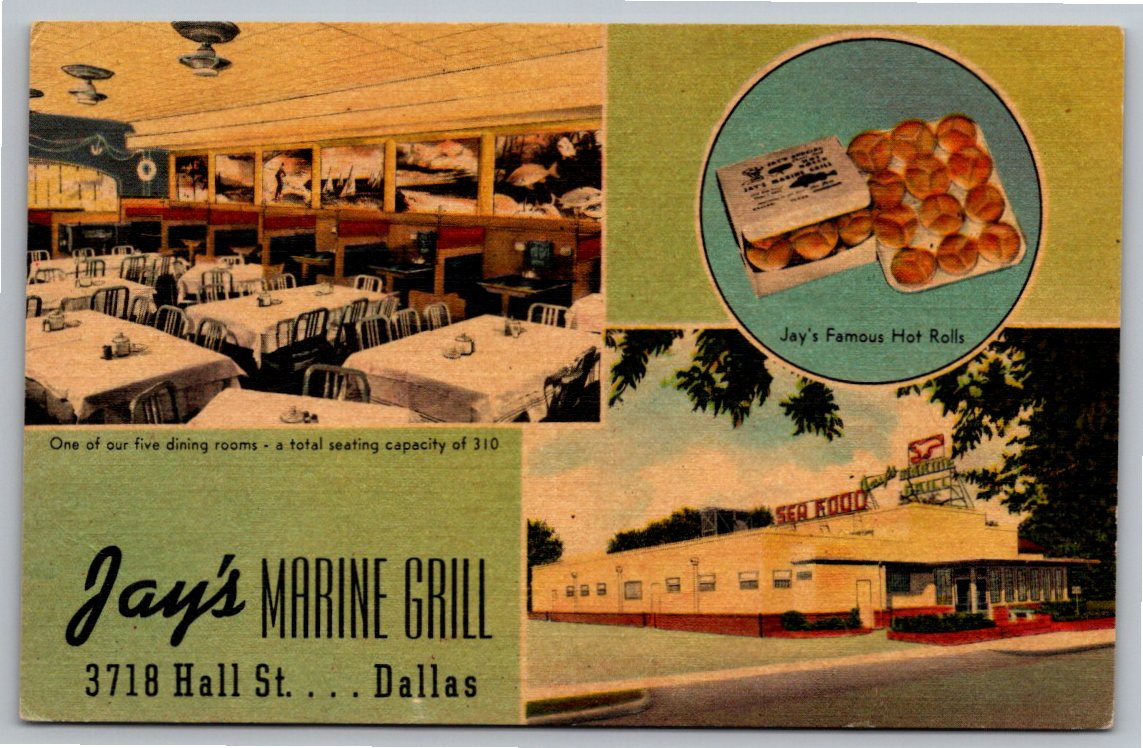
In the 1940s, large-capacity restaurants were designed to accommodate booming post-war crowds, and Jay's Marine Grill was built to serve on an impressive scale. The front of this vibrant linen postcard highlights a multi-view collage detailing the restaurant's key selling points. One interior view showcases a expansive dining room decorated with nautical murals and rows of neatly set tables; the card notes that this space was merely one of five distinct dining rooms, combining for a massive total seating capacity of 310 guests.
Equally prominent on the card is a circular inset depicting "Jay's Famous Hot Rolls." Freshly baked yeast rolls were a defining specialty for many Southern and Texas establishments during this era, often served family-style to keep patrons satisfied while awaiting their main courses. The exterior view captures the building's streamlined, low-slung architectural profile topped with striking neon signage proudly advertising fresh seafood to passing motorists.
Interactive Restaurant Marketing and Local Printing History
Beyond its visual appeal, the reverse side of this postcard reveals a clever promotional campaign devised by the proprietors. The postcard carries a novel instruction in the stamp box: "Give this Card to Waitress; We will mail it." To make sending a greeting as effortless as possible for patrons, the restaurant provided pre-printed cursive text on the left side: "We are enjoying one of Jay's Famous Fish Dinners and the rolls are superb. You sure are missing something." Diners simply needed to write an address, hand the card to their server, and let the restaurant handle the postage—a brilliant form of direct-mail word-of-mouth advertising.
The reverse side also credits the local Dallas publisher, Stellmacher & Son, bearing their catalog number 11,104. Unlike larger national postcard publishers like Curt Teich or Tichnor Brothers, local commercial printers like Stellmacher & Son specialized in regional business ephemera, tailoring custom promotional materials directly for North Texas commercial venues.
A Collector's Keepsake of Historic Dallas Dining
Today, the site at 3718 Hall Street has evolved along with the rest of the bustling Oak Lawn and Uptown districts, making original paper artifacts like this essential historical records of Dallas's mid-century culinary landscape. For collectors of Texas ephemera, restaurant history, or vintage linen postcards, this piece stands as a wonderfully preserved slice of 1940s hospitality culture.