1914 Port of New Orleans Cotton Warehouse & Terminal Postcard
📸 Click any thumbnail to inspect Front, Back & Angles (2 Photos)
As an eBay Partner, we may earn a commission if you make a purchase.
Item Specifications
- Era: 1910s
- Publisher: H. B. Brown / Curt Teich
- Location: New Orleans, Louisiana
- Subject: Port of New Orleans Cotton Warehouses
- Originality: Original Vintage
- Printing Technique: Lithograph
- Category: Postcards & Ephemera
- Format / Type: Vintage Postcards
Looking for Modern Alternatives?
Explore top-rated, modern Postcards & Ephemera and related historical accessories on Amazon.
Shop Postcards & Ephemera on Amazon →As an Amazon Associate, we earn from qualifying purchases.
Historical Context & Overview
Industrial Innovation on the Mississippi River
In the early 20th century, New Orleans stood as one of the world's premier maritime gateways, serving as a vital nexus for global commerce along the Mississippi River. To handle the overwhelming volume of agricultural trade passing through the South, the State of Louisiana Board of Commissioners of the Port of New Orleans commissioned a massive modernization project. Central to this expansion was the Public Cotton Warehouses and Terminal—a state-of-the-art facility engineered to revolutionize the processing, storage, and export of cotton.
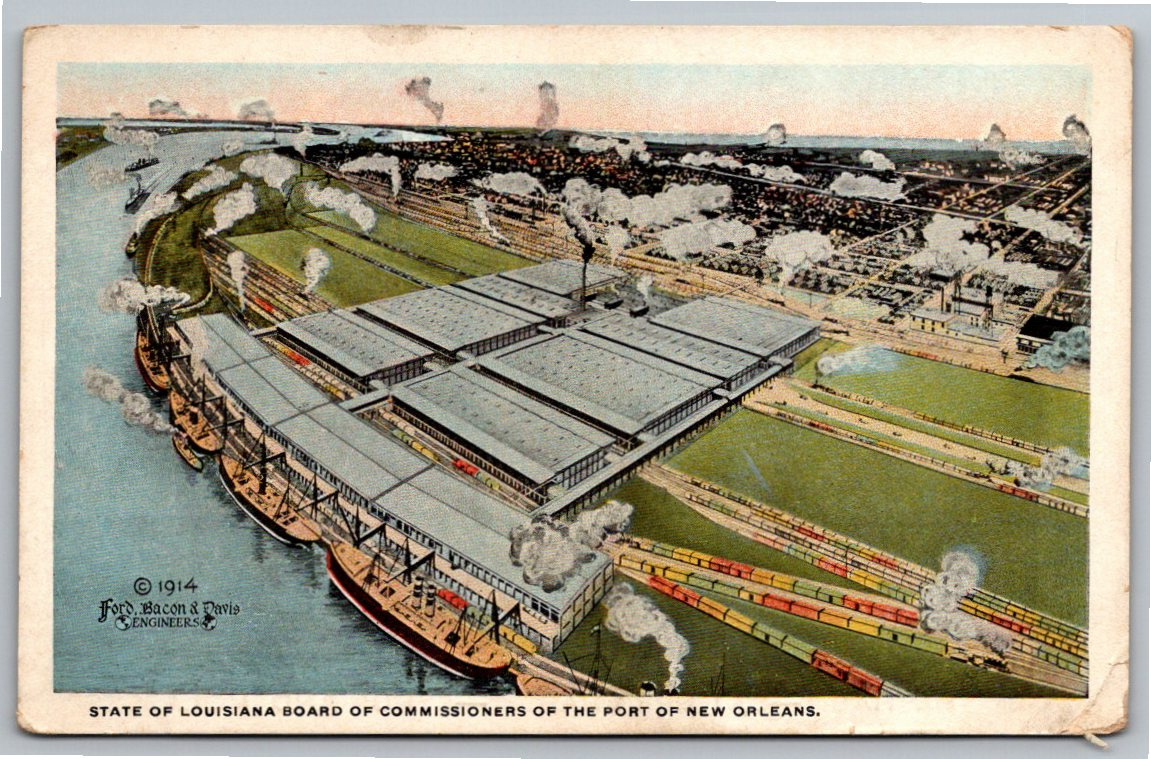
This original 1914 vintage postcard features an intricate bird's-eye architectural rendering created by the famed engineering firm Ford, Bacon & Davis. The dynamic illustration captures the grand scale of the riverfront complex, showcasing steamships moored along the wharves, locomotives navigating extensive rail yards, and expansive storage facilities spanning the waterfront. At the time of its construction, the facility represented a milestone in industrial engineering, designed to process over 425,000 bales of cotton simultaneously.
Architectural Detail and Historical Significance
The front illustration vividly depicts the synchronized ecosystem of transportation that powered Southern trade. Steamships laden with cargo sit along the Mississippi meander, while long lines of freight trains approach the facility's extensive siding network. Plumes of smoke rise from locomotives and ship funnels, symbolizing the energy and momentum of America’s Progressive Era industrial boom. The layout was specifically designed to reduce handling costs and eliminate fire hazards that had historically plagued cotton storage along the docks.
According to the promotional text on the reverse, the ambitious project cost $3,500,000—a monumental sum for 1914—and earned the distinction of being the largest and most complete cotton handling and storage plant in the world. Built and managed under state oversight, it marked a turning point in public infrastructure development for the Gulf Coast region.
Collector Insights and Printing Details
Published locally by H. B. Brown of New Orleans and printed by the renowned Curt Teich Company under their "C.T. American Art" line (bearing production code A-64041), this postcard is an exceptional artifact for collectors of Southern industrial history, maritime heritage, and early 20th-century commerce. The back of the card features standard period formatting, including a one-cent domestic postage rate box and an intriguing regional promotional tagline across the bottom margin: "GET THE HABIT—EAT BRER RABBIT—SYRUP AND MOLASSES."
Whether added to an collection focusing on Louisiana history, industrial architecture, or early postcard graphic design, this unposted card offers a captivating visual record of New Orleans at the height of its commercial waterfront legacy.